- Details
J.L.Carr’s short novel ‘A Month in the Country’ recounts the distant cherished memories of a long hot summer recounted by the narrator, Tom Birkin.

Like all great novels Carr’s masterpiece conjurs with a series of overlapping themes.
There is the trauma and healing of the years following the First World War where Birkin served as an advanced signalman in the trenches. This mirrors the ongoing cost of the Great War on the people of the fictional Yorkshire village of Oxgodby where Birkin finds himself.
There is the theme of sanctuary where Birkin, hiding from the break-down of his married life in London, seeks the solitude and safety of this idyllic setting.
But behind these overlapping themes comes the theme of judgement.
Through the pages of this book judgement is writ large in the form of Birkin’s employment. An art restorer, Birkin’s task through the novel is to uncover and restore a medieval ‘Doom’ painting on the wall of the small church in Oxgodby.
As the novel begins this theme of judgement is present in everything Birkin does. As he painstakingly begins to uncover this great image of Christ sitting in Majesty we hear those great mediaeval pronouncements of judgement:
And he shal com with woundes rede
To deme the quikke and the dede…
And as he reveals this tableau of judgement we hear Birkin’s own judgement on the people that he encounters. Birkin, a Londoner, initially struggles with Yorkshire, which he sees as “enemy country”. He is dismissive of his employer: “Much can be said against the Rev’d J.G. Keach" Birkin says, “But when he stands at the Judgement Seat, this also must be said in extenuation – he was business like.” Sleeping in the Belfry of the church to save money he pours judgement on all he has met:
"‘And what about poor Birkin, did any of you offer him bed and board?’ Yes, you blasted smug Yorkshire lot, what about Tom Birkin – nerves shot to pieces, wife gone, dead broke? Yes what about me?"
In Oxgodby Birkin finds himself literally and figuratively standing in a place of judgement where his initial brittle judgements mirror the judgement of the slowly uncovered wall painting.
This form of judgement, writ large in these great Doom paintings, looks ahead to the end of time and the chief activity of Christ. Through them we see an image of God’s Judgement which is sudden, terrifying, and certain. Often painted on the Chancel arch of a Church to remind all in the congregation of the Judgement that lay ahead of them. As Tom Birkin describes the Oxgodby Doom.
[The uncompromising] Christ in Majesty at its apex, the falling curves [of the arch] nicely separating the smug souls of the Righteous trooping off-stage north to Paradise, from the Damned dropping (normally head first) into the bonfires.
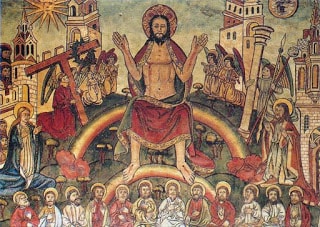
It is easy for us to dismiss these Doom paintings as a relic of a bygone era, but they should remind us of the deep question of faith we too often skate over; what will come of us when we stand in the place of Judgement?
It is an inescapable fact of scripture that judgement stands before all of us. In this Advent season, and as we consider the Four Last Things, we come today to that theme of judgement.
It would be nice to think that judgement is one of those red-blooded Old Testament themes that Jesus helpfully softens for us. But as we see in John the Baptist’s prophesy in our Gospel Reading, Christ comes in judgement:
His winnowing-fork is in his hand, and he will clear his threshing-floor and will gather his wheat into the granary; but the chaff he will burn with unquenchable fire.
Judgement is inescapable in scripture.
However too often the Church has been flat-footed as it speaks of judgement. Judgement, the Church has too often said with a certainty beyond its pay grade, is definitely for those with different backgrounds, different orientations, different beliefs who have the unhappy misfortune to be unlike us.
In this way the judgement of the Church has existed as a projection of the prejudices carried by the one doing the judging. So, the uncompromising Christ in majesty of the Doom paintings tells us about the concerns of the mediaeval mind.
Equally Birkin’s initial judgement of the people of Oxgodby tells us about the anger and grief he carried with him to that idyllic place that summer in the 1920s.
The limit of these approaches is that judgement, if we speak of it at all, is seen solely as an aspect of God’s future activity.
But there is another way to think of judgement.
In our reading from Isaiah we find that judgement still lies ahead of us, but it exists as the consummation, the final act, of the transformation God promises to all creation here and now.
In our reading from Isaiah we hear vividly of the promise of this transformation which is grafted from the deep roots of God’s deep promise to his people.
A shoot shall come out from the stock of Jesse,
and a branch shall grow out of his roots.
The judgement that will come is then drawn from this same root. It will not be about whether we have been good and bad, what it right or wrong. The promised judgement of God will be a reflection of God’s true nature revealed through his ongoing promise for his creation.
God’s judgement is not a future action, but an outflowing of this vision of justice and peace where the most vulnerable are treated with the same dignity as the strong; where all can live without fear.
The wolf shall live with the lamb,
the leopard shall lie down with the kid,
the calf and the lion and the fatling together,
And out of this vision emerges the one who judges from the heart of this promise: “a little child shall lead them” Isaiah says.
As Carr’s novel develops so does the theme of judgement.
As the story continues we find that Birkin changes. So, his gruff and uncouth Yorkshire brethren change from an enemy to become a symbol of a gentler and more innocent time he fears will be lost in the march of modernity. The Churchgoers he ridicules at the beginning show him generosity and hospitality, mostly through the life of the Methodist Chapel, drawing him into the innocent joys of their collective life. Even his view of the Rev’d J.G. Keach is softened, if not overcome, through his growing fascination and infatuation with Keach’s young wife Alice.
Through his time in Oxgodby Birkin is transformed. Birkin, who is standing in his place of judgement is transformed through his experience of that place of judgement.
Carr’s novel is not a quasi-religious text, and is in many ways powerfully critical of organised religion. But it does act as an allegory through which we can reflect on the theme of judgement this Advent.
In Advent we stand, as Birkin does, in a place of judgement. But this judgement is not a distant future act, it is as Isaiah reminds us, the final outworking of God’s transforming promise to creation here and now.
As we consider this promised judgement, as we think on this Last Thing, God does not invite us to consider where we might place ourselves stand on the chancel arch of judgement. God invites us to remake ourselves in the light and love of his transforming promise; to be led by that little child who will, at the end of all things, judge both the quick and the dead.